Accurate Coding That Supports Better Claims and Revenue Cycle Performance
Improve Coding Accuracy With Professional Medical Coding Services
Medical billing is more than submitting claims. Every claim must carry accurate patient, provider, insurance, diagnosis, procedure, and billing information through a process that involves payers, clearinghouses, and multiple administrative checks.
Healthcare Revenues provides professional medical billing services designed to help healthcare providers improve billing accuracy, reduce avoidable claim problems, and maintain a more consistent path from patient encounter to payment.
Our billing team manages essential billing activities, monitors claim status, addresses rejected and denied claims, and works to keep outstanding accounts moving toward resolution.
Spend less time dealing with billing issues and more time focusing on your patients.
Turning Clinical Documentation Into Standardized Codes
Medical coding is the process of translating information from clinical documentation into standardized diagnosis, procedure, and service codes used for healthcare billing, reporting, and other administrative purposes.
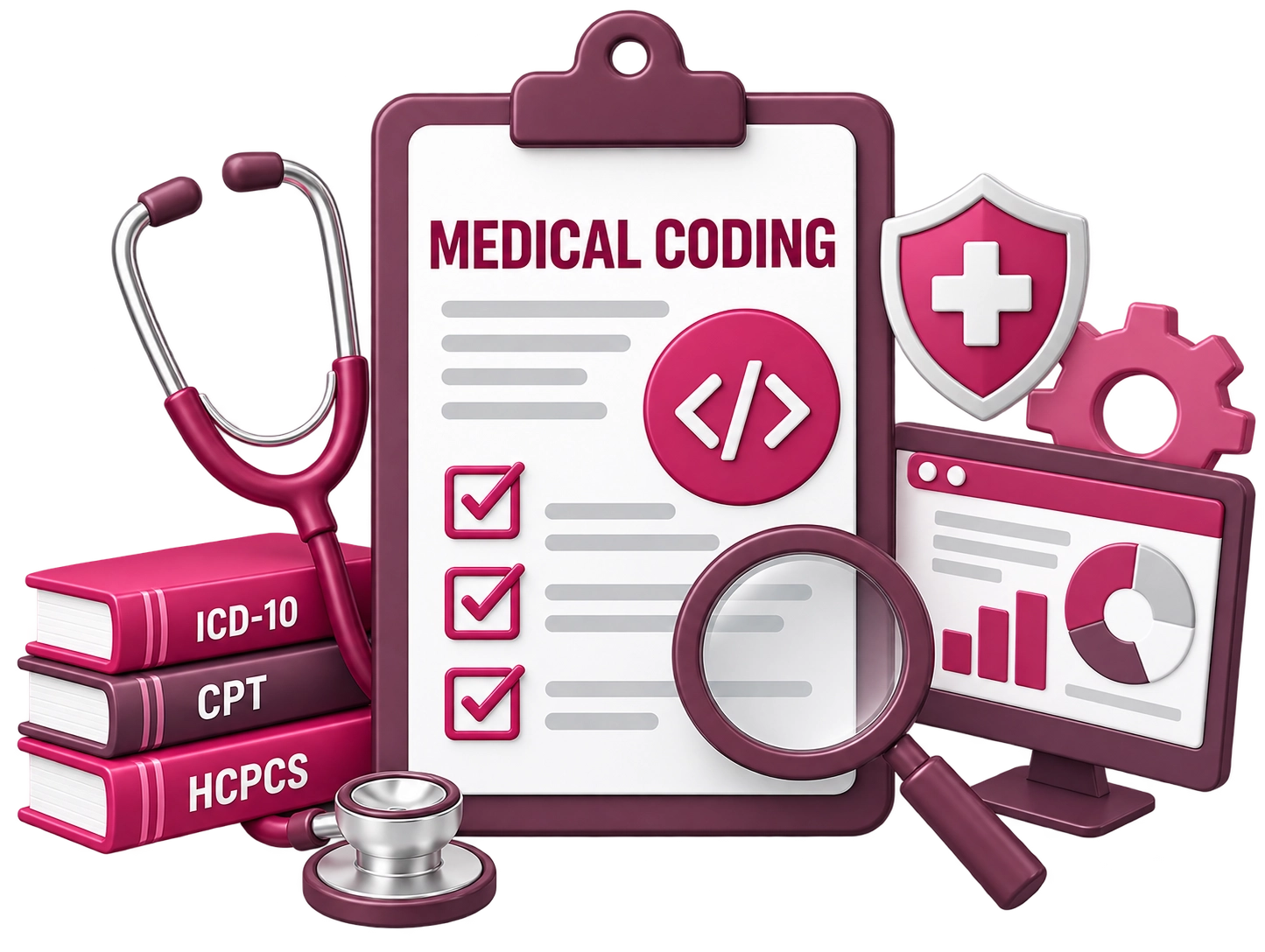
Depending on the service and setting, coding may involve systems such as:
ICD-10-CM for diagnosis coding
CPT for many professional services and procedures
HCPCS Level II for certain products, supplies, services, and procedures
Applicable modifiers and other claim-related coding information
The codes assigned should accurately reflect the services provided and the documentation supporting those services.
Medical coding therefore requires more than simply finding a code that appears to match a procedure or diagnosis.
The coder must consider the clinical documentation, coding guidelines, applicable requirements, specificity, modifiers, payer considerations, and the overall context of the encounter.
Why Accurate Medical Coding Matters
Coding Errors Can Affect the Entire Revenue Cycle
Medical coding is one of the earliest points where clinical information becomes financial information.
When coding is inaccurate or incomplete, the impact can extend beyond the coding department.
Potential consequences can include:
Claim rejections
Claim denials
Payment delays
Incorrect reimbursement
Increased A/R
Additional claim corrections
Compliance concerns
Increased administrative workload
Inaccurate reporting
Accurate coding helps create a stronger connection between what happened during the patient encounter and what is ultimately submitted for reimbursement.
Healthcare Revenues focuses on documentation-supported coding designed to help providers maintain accurate billing workflows without relying on unsupported or unnecessarily aggressive coding.
Comprehensive Coding Support for Healthcare Organizations
Our Medical Coding Services
Healthcare Revenues provides medical coding services that can be tailored to your specialty, practice size, documentation processes, payer mix, and operational requirements.
Our services can support both ongoing coding operations and targeted coding review projects.
ICD-10-CM Coding
ICD-10-CM codes are used to represent diagnoses and other health-related conditions in applicable healthcare settings.
Our coding team reviews documentation to identify the diagnosis information that is appropriately supported by the medical record.
Our ICD-10-CM coding support can include:
Diagnosis coding
Code selection
Specificity review
Documentation review
Code validation
Coding quality checks
Identification of potential coding discrepancies
The objective is to ensure that diagnosis coding accurately represents the documentation available for the encounter.
CPT Coding
CPT coding is used to report many physician and other qualified healthcare professional services and procedures.
Our CPT coding support can include:
Procedure code selection
E/M coding
Procedure coding
Service-level review
Documentation-to-code comparison
Modifier review
Coding accuracy checks
CPT coding should reflect the service actually documented rather than simply selecting the code associated with the highest potential reimbursement.
HCPCS Coding
HCPCS Level II codes are used for various products, supplies, services, and procedures that may not be represented through CPT alone.
Healthcare Revenues can provide HCPCS coding support where applicable to your organization’s services and billing requirements.
Our team can review relevant documentation and billing information to support appropriate code selection.
Evaluation & Management (E/M) Coding
Accurate E/M Coding Based on Documentation
Evaluation and Management services are an important component of professional medical billing.
E/M coding can require careful review of the documentation and the applicable coding requirements for the service being reported.
Our E/M coding support can include:
Office and outpatient E/M coding
Established patient encounters
New patient encounters
Documentation review
Medical decision-making review
Time-based coding review where applicable
Modifier review
Coding consistency checks
Our approach is documentation-driven: the code should be supported by the services and information documented for the encounter.
Modifier Review
The Right Code May Still
Need the Right Modifier
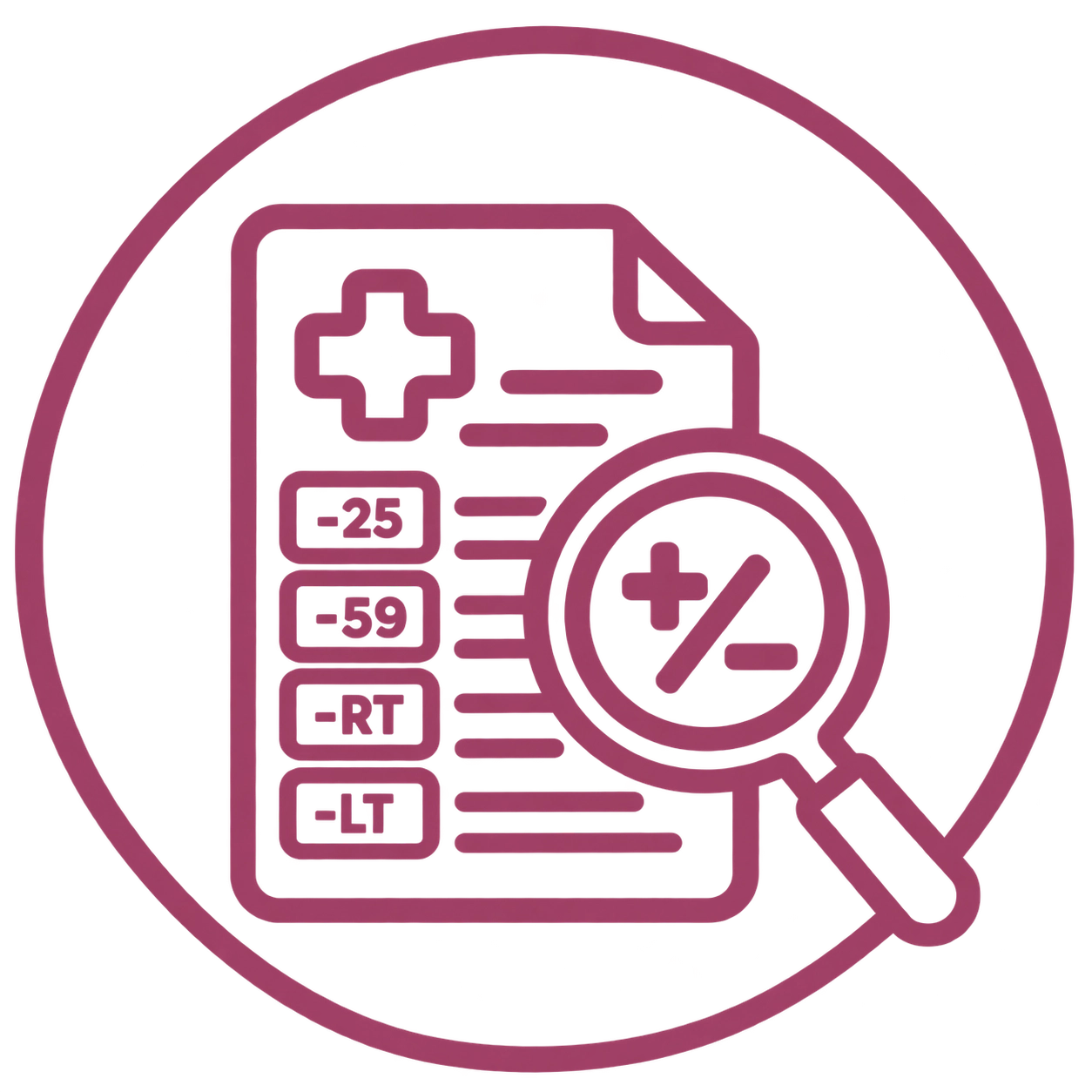
Modifiers can provide additional information about how a service was performed or reported.
Incorrect, missing, or inappropriate modifiers can affect claim processing and reimbursement.
Our coding review can help identify situations where modifier application should be evaluated based on the applicable coding and payer requirements.
This may include review of:
Procedure modifiers
E/M-related modifiers
Bilateral services
Multiple procedures
Distinct procedural services
Professional and technical components
Other applicable modifier scenarios
Modifier selection should always be supported by the circumstances documented for the service.
Coding Expertise That Reflects Your Specialty
Specialty-Specific Medical Coding
Medical coding is not identical across every healthcare specialty.
Different specialties may involve different procedures, diagnoses, documentation requirements, coding patterns, payer policies, and compliance considerations.
Healthcare Revenues provides coding support for a broad range of specialties, including:
Each specialty page provides detailed information about the unique medical coding requirements and challenges associated with that area of care.
Identify Coding Issues Before
They Become Larger Problems
A coding review can help healthcare organizations evaluate whether coding practices are consistent with documentation and applicable coding requirements.
Our coding review process may examine:
Diagnosis coding
Procedure coding
E/M coding
Modifier usage
Documentation support
Code specificity
Coding consistency
Potential billing discrepancies
The purpose is not simply to find errors.
It is to understand why coding issues are occurring and identify opportunities to improve the overall coding workflow.
Coding Compliance & Audit Support
Build a More Consistent Coding Process
Healthcare organizations need coding practices that are not only accurate but also supported by appropriate documentation and applicable requirements.
Healthcare Revenues can support coding compliance initiatives through:
Coding audits
Documentation review
Coding quality assessments
Error identification
Coding trend analysis
Education opportunities
Corrective action planning
Follow-up reviews
Regular coding reviews can help organizations identify recurring patterns and strengthen internal processes.
Important: Coding should never be driven solely by reimbursement goals. The appropriate code should be supported by the services provided and the documentation available.
Medical
Coding Audits
Choosing a medical billing partner means trusting another organization with an important part of your practice’s financial operations.
Healthcare Revenues focuses on providing structured billing support built around:
Documentation
Does the medical record support the codes submitted?
Diagnosis Coding
Are reported diagnoses appropriately supported and coded to the required level of specificity?
Procedure Coding
Do the reported procedures accurately reflect the services documented?
Modifiers
Are modifiers being applied appropriately?
E/M Coding
Are E/M services coded consistently with applicable requirements and documentation?
Billing Alignment
Does the coded information align with the claim being submitted?
The results can help organizations develop targeted improvements rather than relying on assumptions about their coding performance.
Coding for Denial Prevention
Address Coding Issues
Before Claims Reach the Payer
Some claim denials and rejections can be connected to coding-related issues.
Potential problems may include:
Incorrect diagnosis codes
Procedure-code discrepancies
Missing modifiers
Invalid code combinations
Insufficient documentation
Coding inconsistencies
Payer-specific coding requirements
A strong coding workflow can help identify potential problems before claim submission.
When denials do occur, coding analysis can also help determine whether the underlying issue originated in the coding process.
An issue introduced during coding can therefore affect multiple downstream processes.
That is why Healthcare Revenues approaches coding as part of the broader revenue cycle while maintaining coding-specific quality and compliance standards.
Medical coding and medical billing are closely related, but they are not the same process.
Medical Coding
Coding translates clinical information into standardized diagnosis and procedure codes.
Medical Billing
Billing uses coding and other required information to prepare, submit, track, and resolve healthcare claims.
In simple terms:
Coding determines what is being reported.
Billing manages how that information moves through the claims and payment process.
When these functions work together effectively, healthcare organizations can maintain a more consistent path from clinical documentation to reimbursement.
Medical coding depends on the information contained in the medical record.
When documentation does not clearly support the service or diagnosis being reported, coding accuracy can become difficult.
Healthcare Revenues can help identify documentation-related coding issues and recurring patterns that may require attention.
The objective is to create alignment between:
Patient Care → Clinical Documentation → Medical Coding → Claim → Reimbursement
Our review can help answer questions such as:
Does the documentation support the reported diagnosis?
Does the documentation support the reported procedure?
Is the level of specificity supported?
Are relevant clinical details documented?
Are coding inconsistencies recurring across providers?
Are there opportunities for better documentation practices?
Why Choose Healthcare Revenues for
Medical Coding?
Coding Support With a Broader Healthcare Perspective
Medical coding is one component of a much larger healthcare operation.
Healthcare Revenues combines coding expertise with broader capabilities across:
Revenue Cycle Management
Medical Billing
Medical Coding
Medical Credentialing
Front Office Management
MIPS Consulting
PCMH Consulting
HEDIS Consulting
Eligibility & Benefits Verification
Charge Entry & Claim Filing
Payment Posting
A/R Management
Reporting & Compliance
This broader perspective allows us to understand how coding decisions can affect billing, claims, denials, A/R, quality reporting, and overall practice operations.
Our goal is to help healthcare organizations establish a coding process that is accurate, documentation-supported, consistent, and aligned with the broader revenue cycle.
Frequently Asked Questions About Medical Coding Services
What are medical coding services?
Medical coding services involve reviewing clinical documentation and assigning appropriate standardized diagnosis and procedure codes for healthcare services.
What does a medical coder do?
A medical coder reviews clinical documentation and translates relevant diagnoses, procedures, services, and other documented information into applicable standardized medical codes.
What coding systems are used in medical coding?
Depending on the healthcare setting and service, medical coding can involve ICD-10-CM, CPT, HCPCS Level II, and applicable modifiers.
What is the difference between ICD-10 and CPT?
ICD-10-CM is primarily used to represent diagnoses and health conditions, while CPT codes are used to report many professional healthcare services and procedures.
What is HCPCS coding?
HCPCS Level II is a standardized coding system used for various products, supplies, services, and procedures that may not be represented through CPT alone.
Why is medical coding important for billing?
Coding provides essential information used to represent diagnoses and services on healthcare claims. Accurate coding helps create alignment between clinical documentation and the information submitted for reimbursement.
Can medical coding affect claim denials?
Yes. Coding-related issues can contribute to claim rejections or denials. Examples can include incorrect codes, modifier issues, coding inconsistencies, or documentation that does not adequately support the reported services.
Do you provide specialty-specific medical coding?
Yes. Healthcare Revenues provides coding support across multiple medical specialties and can structure coding workflows around specialty-specific services and documentation.
What is a medical coding audit?
A medical coding audit is a structured review of coded healthcare encounters to evaluate coding accuracy, documentation support, consistency, and compliance with applicable coding requirements.
Can you help identify coding errors?
Yes. Coding reviews and audits can help identify potential coding discrepancies, documentation issues, modifier concerns, and recurring coding patterns that may require corrective action.
Can medical coding services be combined with medical billing?
Yes. Medical coding and medical billing are closely connected. Healthcare Revenues can provide both services as part of a broader billing or revenue cycle management solution.
Do you provide coding support for MIPS?
Medical coding and MIPS are separate functions, but accurate documentation and coding can contribute to the broader data and reporting environment used by healthcare organizations. Healthcare Revenues also provides dedicated MIPS consulting services.
Strengthen Your
Medical Coding Process
Accurate medical coding helps connect the care documented by your providers with the claims submitted by your billing team.
Healthcare Revenues provides professional medical coding services designed to support accurate, documentation-driven coding across a range of healthcare specialties and organizations.
Whether you need ongoing coding support, specialty-specific coding, coding audits, or help identifying recurring coding issues, we can build a solution around your organization’s needs.
Ready to Improve Your Coding Accuracy?
Get a closer look at your current coding and revenue-cycle processes with a Free Practice Audit.